No Blueprint For this.
Nobody hands you a blueprint for loving more than one person. RH reflects on building relationships without a set of plans—and learning that sometimes love isn’t about fixing the problem. It’s about showing up, having the hard conversations, and trusting the foundation you’ve built together.
From RH’s
I make my living building things.
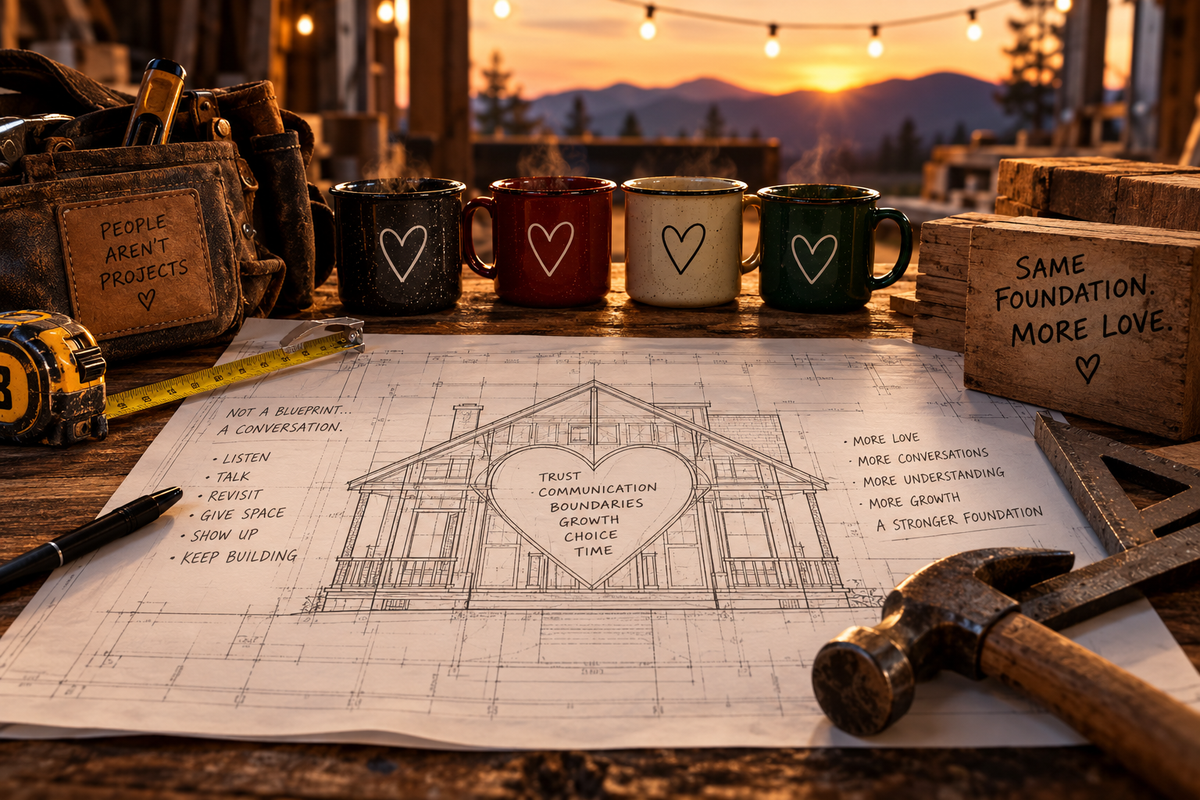
Give me a set of plans, a tape measure, and enough coffee, and I can figure out just about anything. Houses make sense to me. You start with a foundation, follow the blueprint, and if something goes wrong, you fix it.
Relationships don’t work like that. Especially when you decide to love more than one person. Nobody hands you a blueprint for this.
There isn’t a school of YouTube video called How to Navigate Polyamory Without Losing Your Mind. There aren’t many older couples down at the hardware store swapping stories about jealousy, boundaries, and group chats over coffee.
Most of us grew up being told love looked one way. You meet somebody, fall in love, get married, raise kids, grow old together. That’s the plan. And honestly? That’s the plan I thought I was living.
Then life threw me a curveball. Somewhere along the way, our story changed. What started as exploration turned into friendships, and those friendships turned into something a whole lot deeper than any of us expected.
Turns out, love doesn’t always stay inside the lines. What nobody tells you is that loving more than one person isn’t really about adding people. It’s about adding conversations.
A lot of conversations.
Some fun. Some awkward. Some that make you question everything you thought you knew about yourself. Because when there isn’t a blueprint, you have to build one together.
You talk about boundaries. Then you revisit them. You talk about fears. Then you revisit those. Sometimes it’s just needing reassurance from the people you love.
I’ve learned that being a tough guy doesn’t help much if you can’t talk about what’s going on in your own head.
Trust me, I tried.
For most of my life, my solution to everything was simple: work harder. If something felt off, I’d throw myself into a project. Frame a wall. Pour a slab. Remodel a bathroom. Stay busy.
Turns out, you can’t outwork your feelings. Polyamory has a funny way of dragging every insecurity you’ve got out into the daylight and setting it on the kitchen table for everybody to look at. Not exactly comfortable.
But if you’re willing to sit there and have the hard conversations, something pretty incredible can happen. You grow. You learn that love isn’t ownership. You learn that your partner loving someone else doesn’t automatically mean they love you less. You learn that feeling chosen matters to your wife. You learn that reassurance matters to your new love. You learn that your new “brother” can surprise you in the best possible ways.
Most importantly, you learn that relationships aren’t built during the easy times. They’re built during the uncomfortable conversations, the misunderstandings, and the moments when everybody could walk away but chooses to stay instead.
I still don’t have this thing all figured out. Truth is, none of us do. One thing I’ve learned over the years is that I can’t fix everything.
That wasn’t an easy lesson for a guy like me. I’m a builder. I see a problem, I want to grab a tool and get to work. Leaky pipe? Fix it. Broken door? Fix it. Relationship issue? Well, my first instinct was always to fix that too. Turns out, people aren’t projects. Who knew?
Sometimes the people you love are hurting, struggling, or working through something that has nothing to do with you. Sometimes they don’t need a solution. They don’t need advice. They don’t need somebody charging in with a hammer and a game plan. Sometimes they just need time.
I’ve learned that not every problem needs to be fixed immediately. Some things work themselves out if you give them room to breathe. Some fears settle down. Some emotions need to be felt before they can be understood. Some conversations happen when everybody’s ready, not when I think they should happen.
That doesn’t mean you stop showing up. It just means you learn the difference between standing beside someone and trying to carry them.
As much as I hate it, sometimes the best thing I can do is put down the tools, sit quietly, and trust the people I love to find their own way.
RH’s Final Thought: I’ve rebuilt enough houses to know this: if the foundation is solid, you can repair just about anything sitting on top of it. Relationships aren’t much different.